

hey friends
i have come to realize that writing is an essential part of keeping myself grounded to my craft.
i am going to go through the performance of my portfolio later in this post, but i’d like to address this first.
yesterday, i (and when i mean i, i mean chatgpt) compiled all my old paid articles from 2023 until now, 94 articles and 1364 pages of content, and sent them to all the members that were at some point paid members of this newsletter.
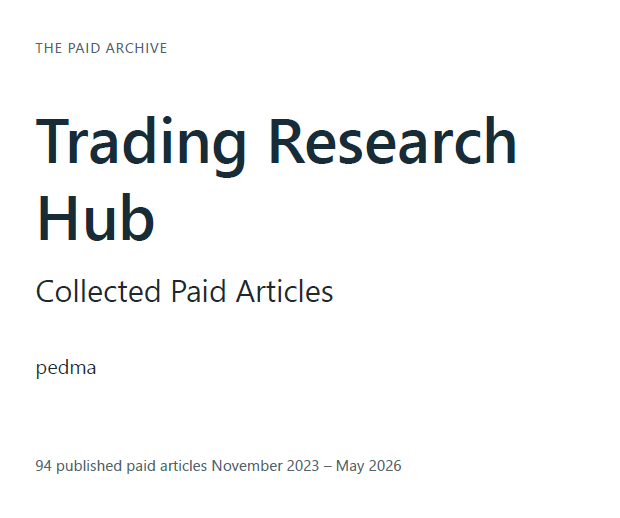
(before you ask, i am not making this PDF available publicly anytime soon, out of respect for the earlier supporters of this newsletter, maybe next year, and i’ll do it for free.)
i took a quick read through these old articles, and it reminded me how much I actually enjoy writing stuff. going back on my thoughts in 2023, it is so interesting man. it’s like a snapshot to a past version of yourself.
for some time now I have been feeling disconnected from my craft. disconnect in a way that i feel like a cog in a machine, not thinking through anything, just watching this thing, that we call AI, pushing new stuff into production. you get detached from the process of understanding, and you don’t really get penalized for it anymore these days (for the most part).
in the early days of AI, you’d have to guide it step by step, and the larger the request, the higher the odds it made an error somewhere. so you were in some way forced to think through each logical step and review the code. but now with the frontier models, you can give it a massive undertaking, and it will usually oneshot the output, just depends on how much money you’re willing to throw at it.
but when i do this, i trade taste for speed, and i do miss the taste of a successfully handcrafted output. like a chef tasting the food he just put through a bimby machine (that kitchen appliance thingy).
before when I cracked a problem, it felt amazing. a simple example was when i was for the first time creating a long/short script for a momentum model. it seems simple, but it wasn’t that simple when you had to handcraft the code. at least to me it wasn’t. it had a lot of interesting details you had to work through. when i finally cracked it, and the positions worked as they should, it felt amazing. and i truly understood the process. you could ask me about the tiniest detail and i’d answer it right on the spot, because i built it. now i’d probably have to ask claude to give me the summary of what it does.
is that wrong? i don’t think it is black and white like that. maybe for broad architecture things yeh, but when it comes to finding edge, risk management, portfolio allocations, etc, i need to understand it deeply.
i am not advocating for going back to coding by hand, thats the same thing as asking farmers to farm with a hoe (eh eh yeh i know) tool, rather than using machines. i am all for efficiency maxxing and there’s beauty in a well built efficient process.
but i guess my point is don’t skip the understanding part, don’t skip the manual tedious process of looking at the output and making sure it’s right, don’t lose that taste for your craft, you’ll need it.
and over time the more you just focus on maximizing the output, the harder it becomes to think deeply about stuff. to really put it “on paper” and understand becomes a hill to climb that you procrastinate until you have to.
I am going to force myself to write something every week. I think it is an useful exercise to think about stuff in depth rather than superficially for the sake of speed.
I think… because, I am not sure. maybe speed and efficiency beats understanding after all, but something tells me that’s not true.
these are my thoughts now, i am just figuring it out as i go, similar to everyone else.
Portfolio Update - 5/11/26
lets now move on to what matters and talk about our performance so far, and think through what we can improve.
at the time of writing this post, the global portfolio is up 51% ytd vs 3.3% for others and -13.2% for BTC.
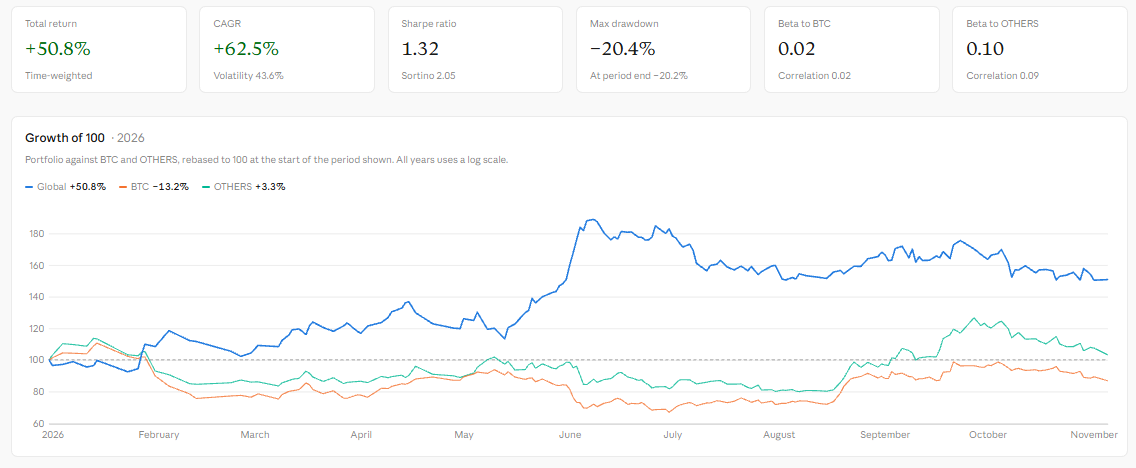
not a bad year considering how hard it was to trade crypto this year. I am glad i put in the work after the 10/10 wake up call.

i know i say this often, but sometimes we learn the most when we are forced to and are willing to listen to what we just learned, not just throw it under a rug because it’s too painful to look at. when times are good, I slow down, and I just get comfortable with what I got going on, which is not optimal. we should have a baseline of things to improve, and lately, that has been slacking off.
but now we must set new goals. I am not fully satisfied with the current performance of my systematic portfolio. there’s still a lot to improve.
for example our sharpe standing at 0.9 for the past full year.
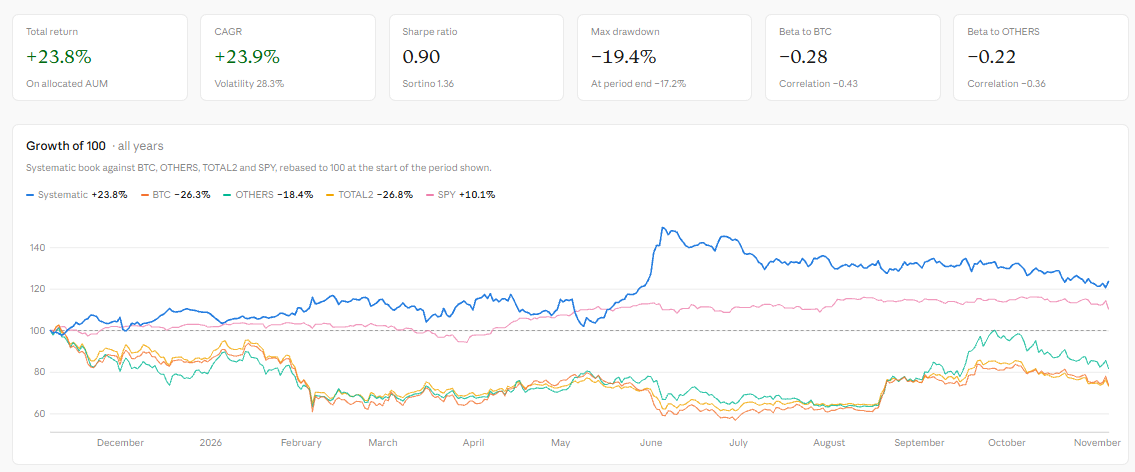
sure we have been developing new models, and the earlier ones were worse and that’s one of the reasons for sharpe being a bit weighed down, but it’s something to improve.

last year (2025) we set the goal of heavily reducing our beta to BTC and altcoins. you can see that the global portfolio, had a beta of 0.93 to BTC and 0.69 to OTHERS. (i dont have great data to isolate the systematic leg back then, but was long-only trend so it wasn’t that different from the global,)
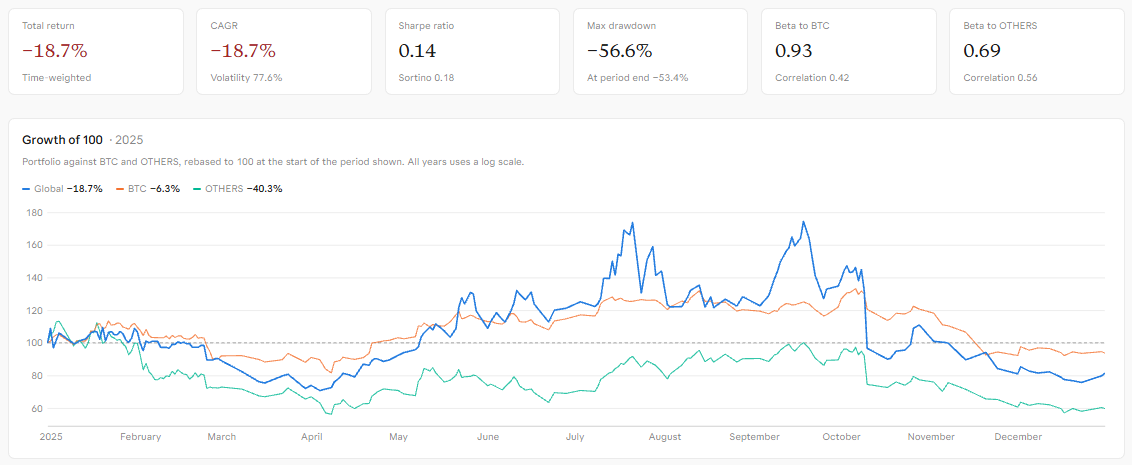
we achieved it as we saw on the chart of the isolated systematic portfolio performance (-0.28 BTC and -0.22 OTHERS), and actually went beyond it to be negative this year on the systematic book. which is something that led me into looking at beta neutralizing each legs so we don’t carry too much beta on any one side. because it’s all fun and games when the market is going down, but when it moves up, well, it sucks a bit when you are carrying too much net notional exposure on the “wrong” side. exacerbated when there’s a momentum crash and the leg that should be hedging the other takes a larger hit than the other.
if we take a look at the historical performance of our system, the exposure we carry has been structurally net short in the past, even through strong positive regimes. we will be discussing this in the next post as I have already been writing it.
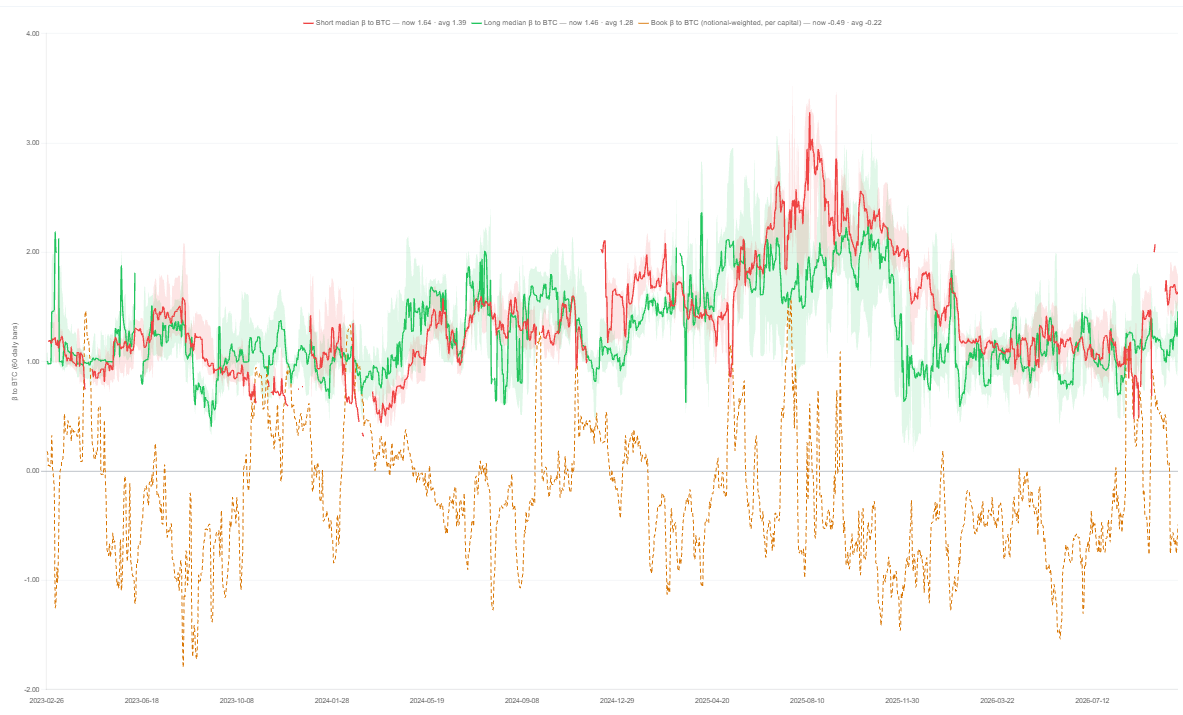
and again that might be a reasonable thing, to put more net notional weight against this market because there’s so many scams, most things trend toward 0 over time, and thus the shorts being a large contributor to the PnL over the last year, the date we’ve had this current model running from.
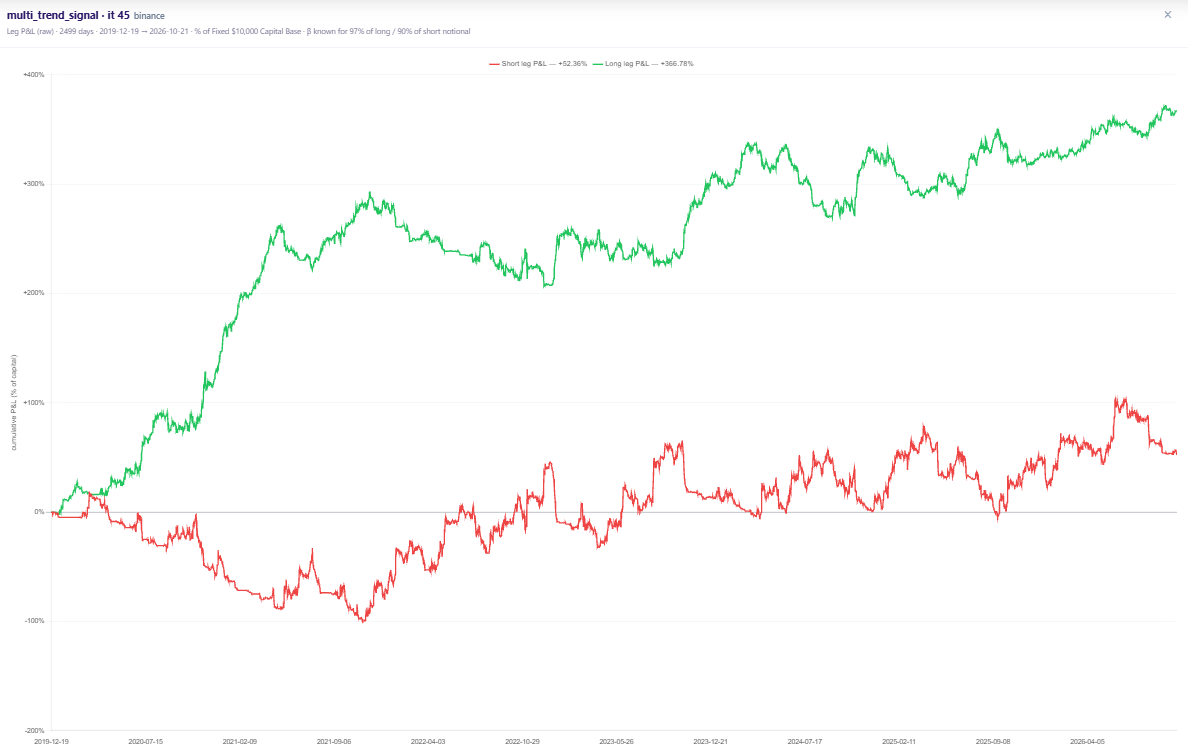
but if we decompose each leg’s PnL from their beta to BTC, we can see that the residual return of the short leg does earn roughly 3-quarters of the residual return and most of the long raw outperformance is BTC beta.
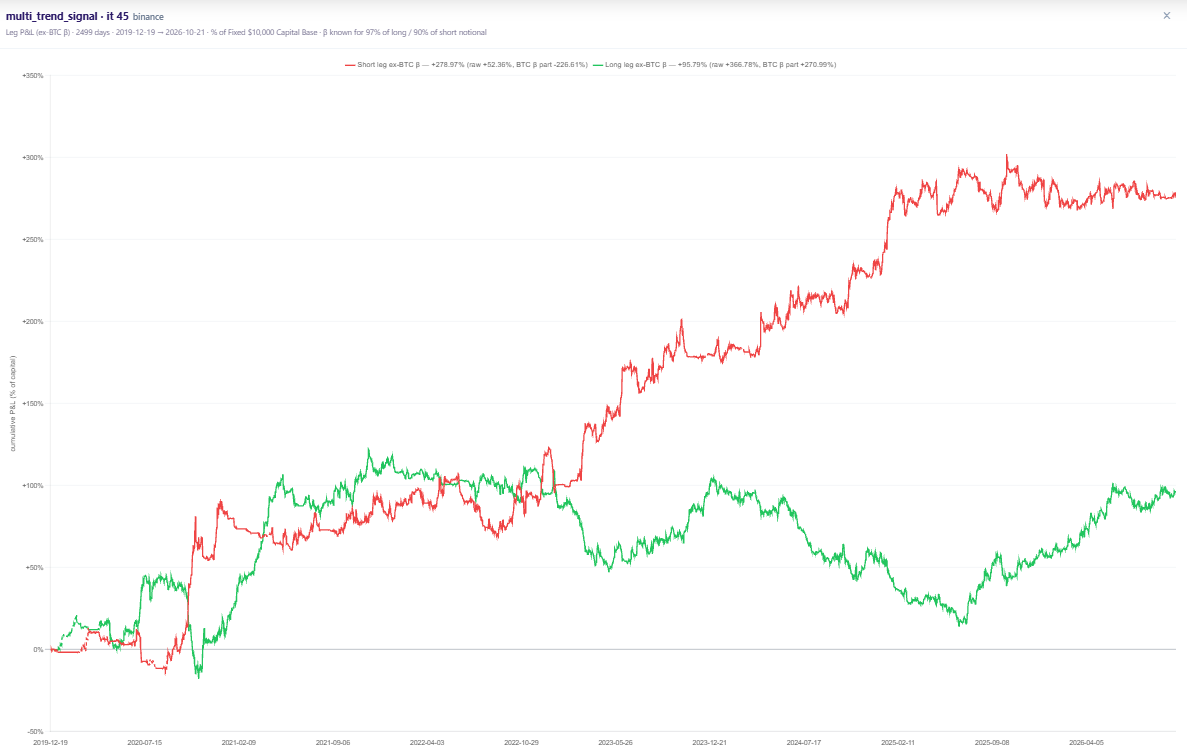
could we bring that beta closer to 0 on average? and would that yield better results? is the tradeoff for higher complexity worth it here? those are questions I am working to answer , but that will require some additional thinking.
also although our main strategy has improved quite significantly from the first iteration in November last year, it’s still the overall same bet, which is something I want to change.
I want to diversify my exposures further. there’s a lot other things we can do at the same time.
so that will be the goal for next year. hopefully in a year’s time you see me writing a post about how many different strategies I am running now. I have the capacity for it, the infrastructure for it, there’s no reason to not have it done.
in the meantime, I will be writing more here as well, getting back on the writing horse let’s say.
see ya next time!
Disclaimer: The content and information provided by the Trading Research Hub, including all other materials, are for educational and informational purposes only and should not be considered financial advice or a recommendation to buy or sell any type of security or investment. Always conduct your own research and consult with a licensed financial professional before making any investment decisions. Trading and investing can involve significant risk of loss, and you should understand these risks before making any financial decisions.