

Hey friends,
I’m reading The Creative Act by Rick Rubin.
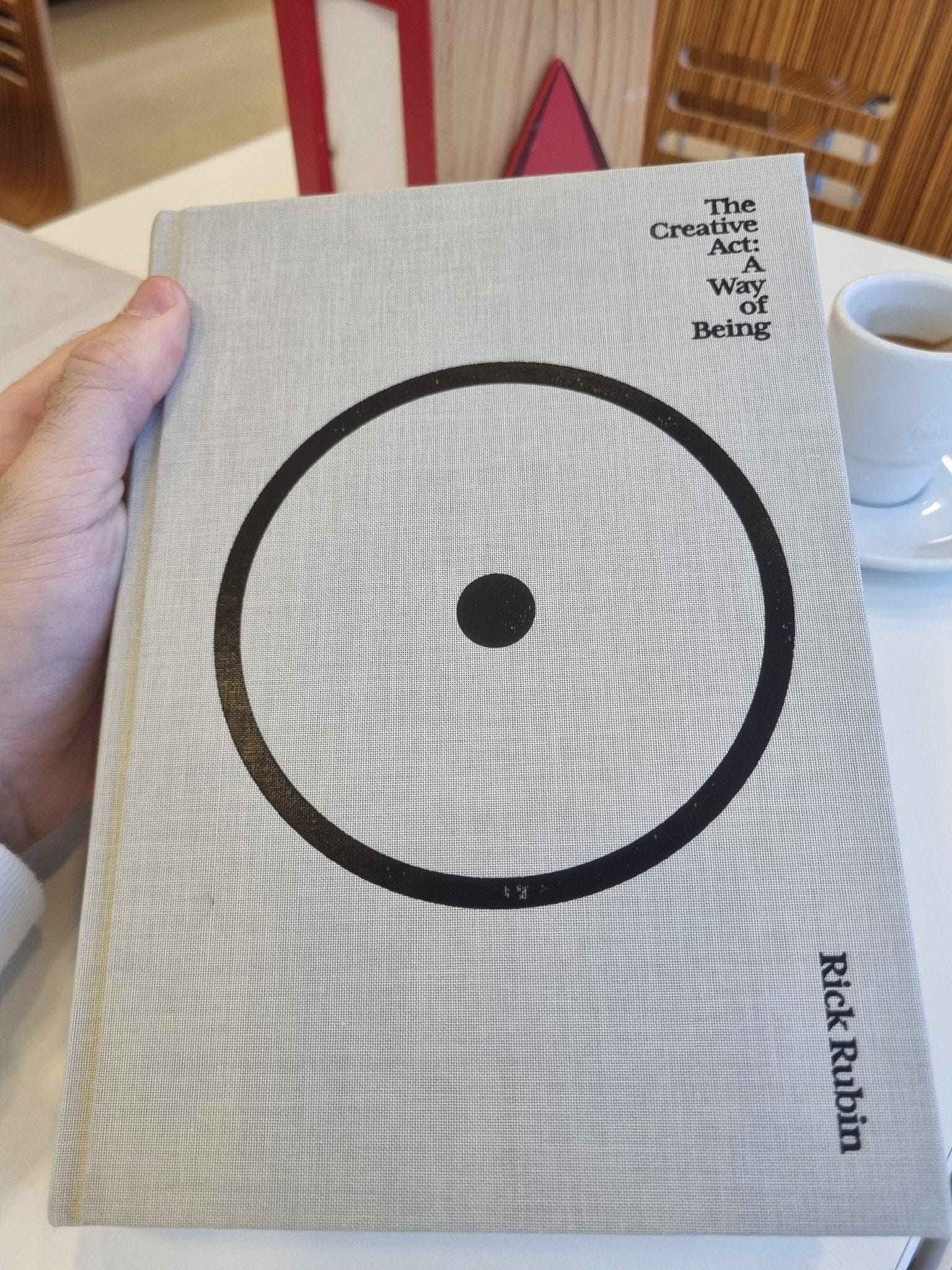
Honestly, I didn’t think much of it at first. It’s a book for artists. I am no artist. I am a trader.
But the more I read it, the more I agree with his concepts around a lot of things being an artistic expression. Even as I’m writing this, I’m thinking about what you might enjoy reading, whether this is going to connect. But is the objective merely to please an audience, or to write new thoughts, new ideas that might be interesting and useful to you?
We allow a lot of our original ideas to be disturbed by logic and filters that we set. But what if we allowed our work to flow with whatever we’re thinking? What if we could be more in tune with our creative process to create new things, in fields where questioning the rules isn’t always accepted well?
Trading as Creative Expression
How can I be an artist in trading? Is there an art to trading?
Well, as laid out in the book, anything we do that creates something that didn’t exist before in the world, that we transmit from our minds into the “real” world, is a form of creative expression.
As a trader, I sometimes land on thoughts and ideas that deeply connect with me. Today I was reading a tweet from ShortBear. It deeply resonated with me because I find it unbelievably true.

I immediately saved it to write about it after I carefully thought about it.
Markets are indeed forward looking machines. We all get so stuck in past data, not realizing that everything with an added “confirmation”, like an abundance of past data, means that it’s probably no longer as good as something where the future is so uncertain that you’d probably get mocked for sharing your idea publicly.
I have traded models with vast amounts of data available, papers written on them, confirmation from good friends of mine that trade those models. None of those models ever paid me like bridging funds to new perp dexes and experimenting with their technology, fully aware that I might lose all my funds.
None of those ideas ever paid me like betting on copies of successful protocols at the peak of the 2021 mania.
None of those ideas paid me like launching a strategy in a new market, with only a few weeks of data and a few heuristics on why that strategy might work, and why that effect should pay me.
Being in those unknown future outcomes seems to be where the highest RR is for me, and I take them each time I find something with that potential. Being in tune with the information that is provided to me, listening and acting on it.
That is art. That is artistic expression as a trader. The ability to consume information and translate it into a system that works.
Be Guided by Beauty
One of the quotes I most like from Jim Simons:
“Be guided by beauty. I really mean that. Pretty much everything I’ve done has had an aesthetic component, at least to me. Now you might think ‘well, building a company that’s trading bonds, what’s so aesthetic about that?’ But, what’s aesthetic about it is doing it right. Getting the right kind of people, and approaching the problem, and doing it right [...] it’s a beautiful thing to do something right.”
— Jim Simons
Building a trading company right, doing it right, is the beauty in it.
Trading is the ultimate expression of art, because we’re on the cusp of the unknown. We’re all betting on a future that has not happened yet, using information from the current. If art is bringing the non-existent into reality, then trading is an art where we’re all trying to make a living despite that unknown future.
To live as a trader is the choice of a hard life. It’s the choice of volatility and never knowing what will happen tomorrow. Some seasons you feel like you’re the man, other seasons you wonder what you’re doing with your life.
Yet you must take these moments and despite them, continue to move forward, with the expectation that your creation will continue to adapt to an ever changing world.
Building and Reflection
Now to get more practical. How can this help me get better at trading?
There’s times I have to build. There’s no way around it. I have no developers around me to do all the coding work while I think about new ideas. So I have to build myself, and at times, that consumes me for months.
That happened for the past 4-5 months.

I’ve done nothing but relentlessly build my new trading infrastructure to handle scalability across multiple models, exchanges, data sources, etc. I literally poured all of my energy into that these past few months.
All because of an idea I had during the summer. An idea that was not just generated from me—it was generated from reading about what other traders I respect were doing and seeing them do well in their fields by adding a bunch of different models together. So I wanted to do the same.
For a long time I was under the impression that I should focus on one thing and one thing only, because I couldn’t do anything else without spending a ton of time on IT, development and maintenance. Although that was true a few years ago, with the help of AI, I am able to express my ideas of what I believe to be solid infrastructure much faster. In a few months, I was able to build something that I never came close to having before.
This takes me into a different topic of how AI can aid you boost your creative efforts. Not REPLACE it, but rather boost.
A coder is an artist. A coder that produces beautiful, efficient, scalable code is an artist in my eyes. Maybe that coder can and will develop at much faster rates than before. I am sure that I am. I am no coder, I am just a trader that codes to trade. AI is amazing to bring my ideas of what good trading is into beautiful, efficient and scalable code, without spending too much time on that task that is not my main occupation.
The Value of Stillness
In any case, there’s times to build, but there should also be time for reflection. Perhaps time where you do nothing but sit on a beach reading, thinking, doing nothing. Just reflecting on what’s around you and where you want to take your venture next.
As I’m writing this, I’m at a cafe. I walked here, about 30 minutes walking, with nothing but my computer and Rick’s book. My ideas flow much better because I can just stop. I’m not mindlessly consuming or focused on building. I’m just thinking about new ideas that came from this book.
That time is useful for me.
The best ideas that I’ve produced in the past, whether in trading or business—have arrived at the times I was having a walk in nature, on a path I have nearby my house. That hour, stuck in nature, with nothing but my thoughts, forces me to think and to create. You can’t ignore your inner thoughts and you have to work through them. To think through them.
And there I created a ton of ideas.
But it doesn’t have to be full quiet. I have listened to great podcasts from traders I respect, and many times I had to pause the podcast to deeply consider an idea discussed. Almost every time I’d get a new idea that I didn’t consider before and took note.
Also these ideas made so much sense to me. Almost as if it was familiar to me, yet I never heard about it before.
Rick, in his book, talks about that. Sometimes you get these familiar ideas that deeply connect with you, that make sense, but that you never heard about before. Those are the creative moments we should seek as traders and researchers. Those ideas that make sense. That can drive you forward in your own trading.
How do we tune ourselves to those good ideas, is the question.
To me, it certainly helps leaving my habitual environment like I said—go on a walk in nature, and consider these ideas with purpose. Allow the mind to wander, to flow, and not put too many constraints, yet try to pursue those ideas.
Also adding external input from traders you respect is a good habit, because it puts ideas in your mind that might manifest in the future. A lot of times I heard a trader say something so out of reach of my current understanding that it goes unnoticed. But after a few months or a year, you run into that problem, because you’re now dealing with more complex problems. And there, the thought, the idea, comes to your mind again and there’s the answer.
Immersing oneself with your field, and consuming everything related to it, is probably a good way to do it.
The Frictionless Testing Environment
On testing ideas.
I had to build an environment where I can test ideas freely and with very little effort.
I mean, I think about an effect or a signal that might have edge, I have to be able to test it within minutes. I need to test with a few lines of code. Each test can’t require a week of changes in the code to make it work. Initially, that might be the case, but for that we need to ensure that each new feature we add to our infrastructure is built with the thought in mind of future scalability.
Because if we view trading as an art, the generation of ideas is part of the creative process. If every time you have an idea, you’re burdened by the dull process of having to re-structure your entire codebase to accommodate for that new idea, you’re going to break off your creative flow and subconsciously associate new ideas with a boring, dull process, of having to do very painful work to get at the result.
That happened to me a lot.
As a result of that—and my own laziness, let’s not try to fool anyone here—I delayed my own expansion into other systems because of that. Every time I wanted to add a new model, I had this feeling of deep pain associated with it, with the knowledge of the work I had ahead. So I accepted ideas such as “I am a trend follower” or these self-affirming beliefs that I must do one thing or the other, rather than viewing my situation as a retail trader advantageous in the form of flexibility.
The process of testing needs to be efficient, almost like a well-oiled machine that flows beautifully and smoothly, not a rusty old machine that breaks each time you add some small degree of improvement.
Here we go back to beauty, like Jim Simons so well put it.
These are just my thoughts on trading and research as a form of artistic expression.
I could be wrong.
Disclaimer: The content and information provided by the Trading Research Hub, including all other materials, are for educational and informational purposes only and should not be considered financial advice or a recommendation to buy or sell any type of security or investment. Always conduct your own research and consult with a licensed financial professional before making any investment decisions. Trading and investing can involve significant risk of loss, and you should understand these risks before making any financial decisions.
If you are into cycles - it is art