👋 Hey there, Pedma here! Welcome to the 🔒 exclusive subscriber edition 🔒 of Trading Research Hub’s Newsletter. Each week, I release a new research article with a trading strategy, its code, and much more.
If you’re not a subscriber, here’s what you missed this past month so far:


If you’re not yet a part of our community, subscribe to stay updated with these more of these posts, and to access all our content.
Hey friends,
A few months ago I learned about a new perp dex running a points program with a pretty reasonable innovation compared to other perp dexes. The problem was, they didn’t have an API. So I had to execute manually each day.
That’s what I did. Below is the equity curve since December — the major jumps are deposits.
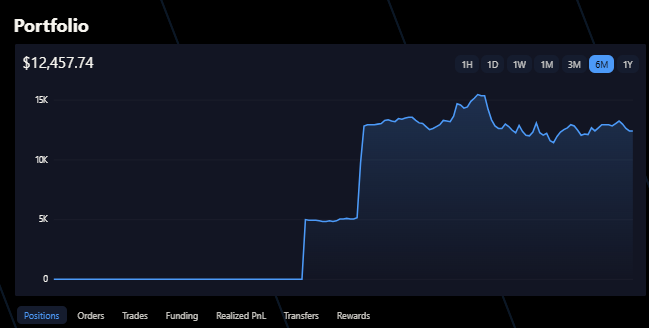
Total deposits have been about $12,500, and we’re sitting at $12,455 equity right now (not doing so great!).
Today I want to actually test this strategy properly — go through the data and figure out if we’re doing something right or not.
For context: when I started trading this, since there was no API, I had to pull data from another exchange and generate signals there to trade here. The goal wasn’t to make a lot of money — it was to not lose much while farming points. We’ve done over $3M in volume on a small account, so we’re achieving that. But I can’t scale it further unless I can make the strategy actually work.
So I collected a bunch of data and today we’re running through it.
The idea is pretty basic. Perpetual contracts pay funding to incentivize one side to converge with the underlying. When the perp drifts too far from spot, the mechanism kicks in: it pays the side that pushes price back toward convergence, and charges the side pushing away from it — based on their notional size.
A simple carry strategy would be to go long the lowest-funding coins, short the highest-funding coins, collect the spread. This is simple enough that we can use to collect points on these perp dexes, since they reward OI (open interest) more than most other metrics, it’s pretty easy to maintain, and it makes sense why we should get paid for it.
But turns out, it isn’t as simple as I thought. Story of our life innit?
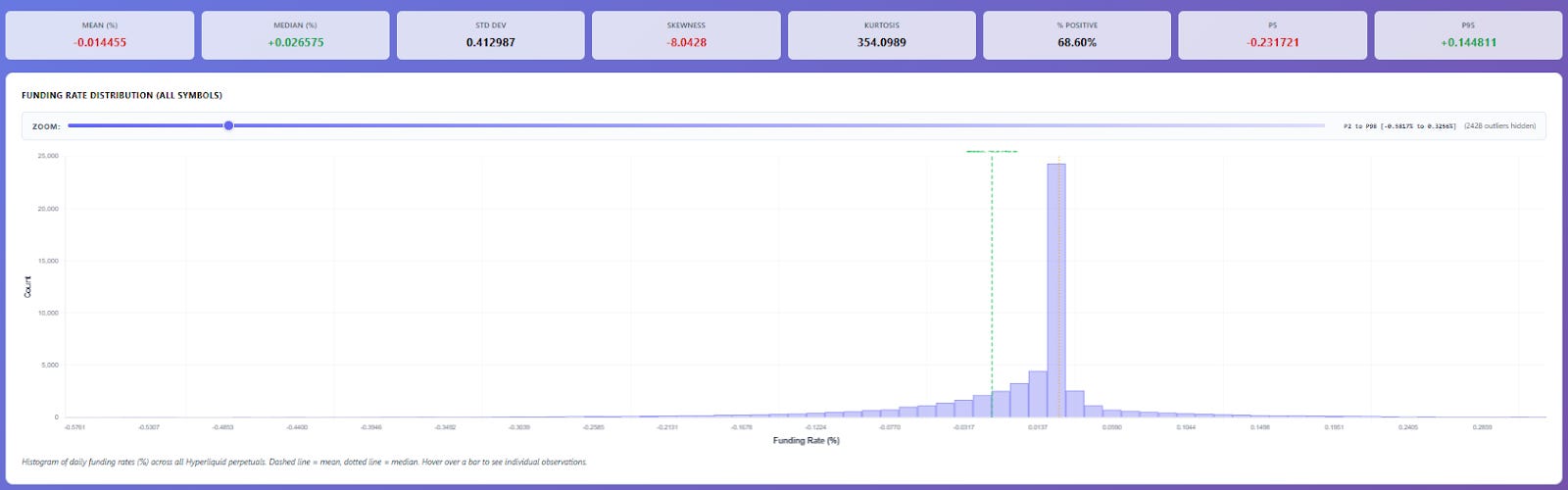
Let’s look at some data first. How do funding payments actually distribute across assets?