

👋 Hey there, Pedma here! Welcome to the 🔒 exclusive subscriber edition 🔒 of Trading Research Hub’s Newsletter. Each week, I release a new research article with a trading strategy, its code, and much more.
If you’re not a subscriber, here’s what you missed this past month so far:


If you’re not yet a part of our community, subscribe to stay updated with these more of these posts, and to access all our content.
Hi friends,
We have to take a break from our series on the dirty carry trade (part 1 and part 2) to look at an interesting concept that I found when running my systems though different exchanges.
Below there’s 4 simulated equity curves, by exchange (binance, extended, hyperliquid, kraken) for a standard crypto momentum model.
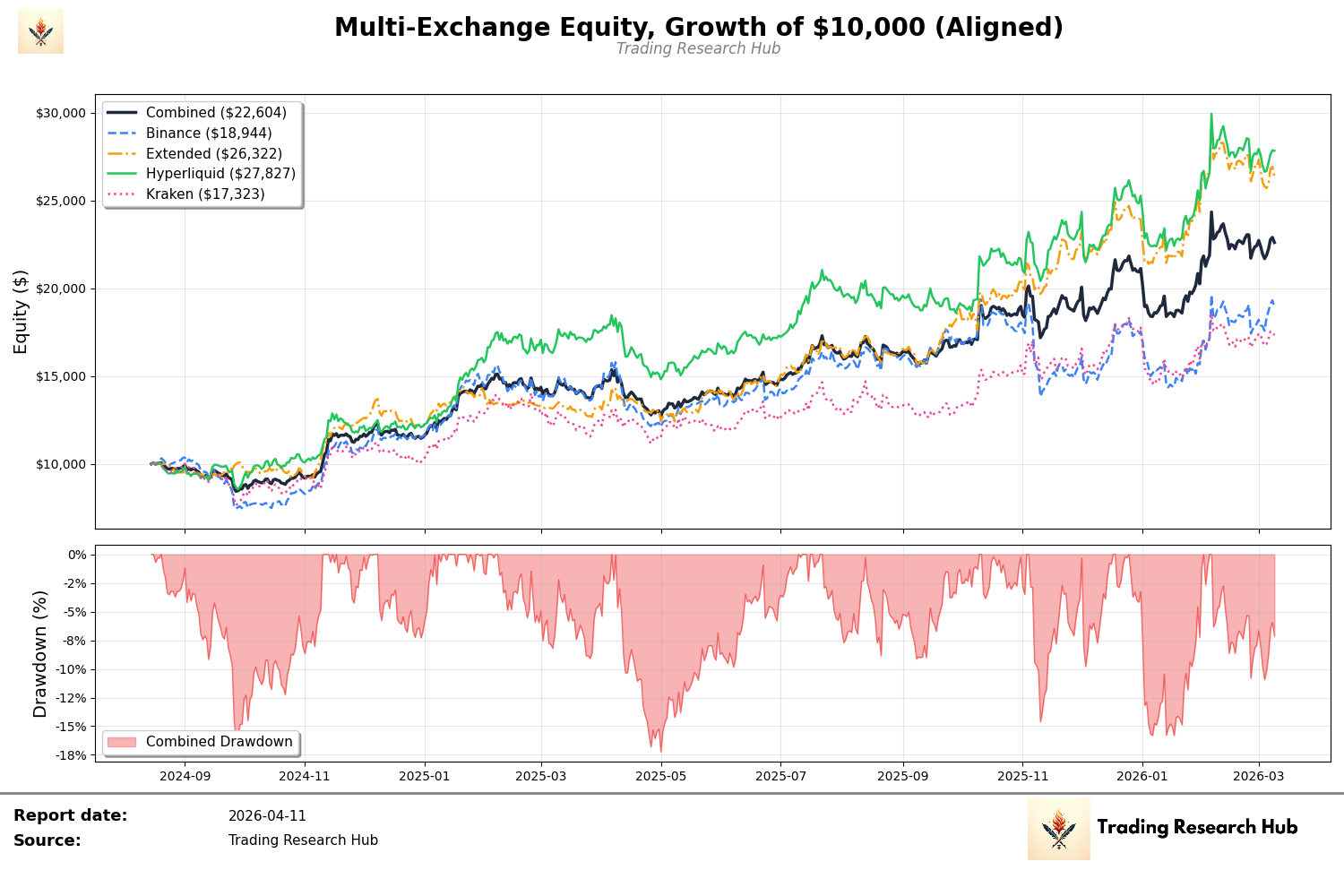
As we can see, there’s a considerable disparity between DEXE’s (decentralized exchanges) and CEXE’s (centralized exchanges). The distinction between a DEX and CEX is probably not the root cause here but rather the second order effects that newer exchanges might create. I have a few other ideas about why this might be the case, but let’s prove it with some data and figure it out.
This is an exploratory article, as that’s what’s most useful to me when there’s no solid answers, like right now as I am writing this… just a thesis and a dream (just kidding sounded nice).
Let’s begin by taking a look at the individual day’s returns for each exchange.
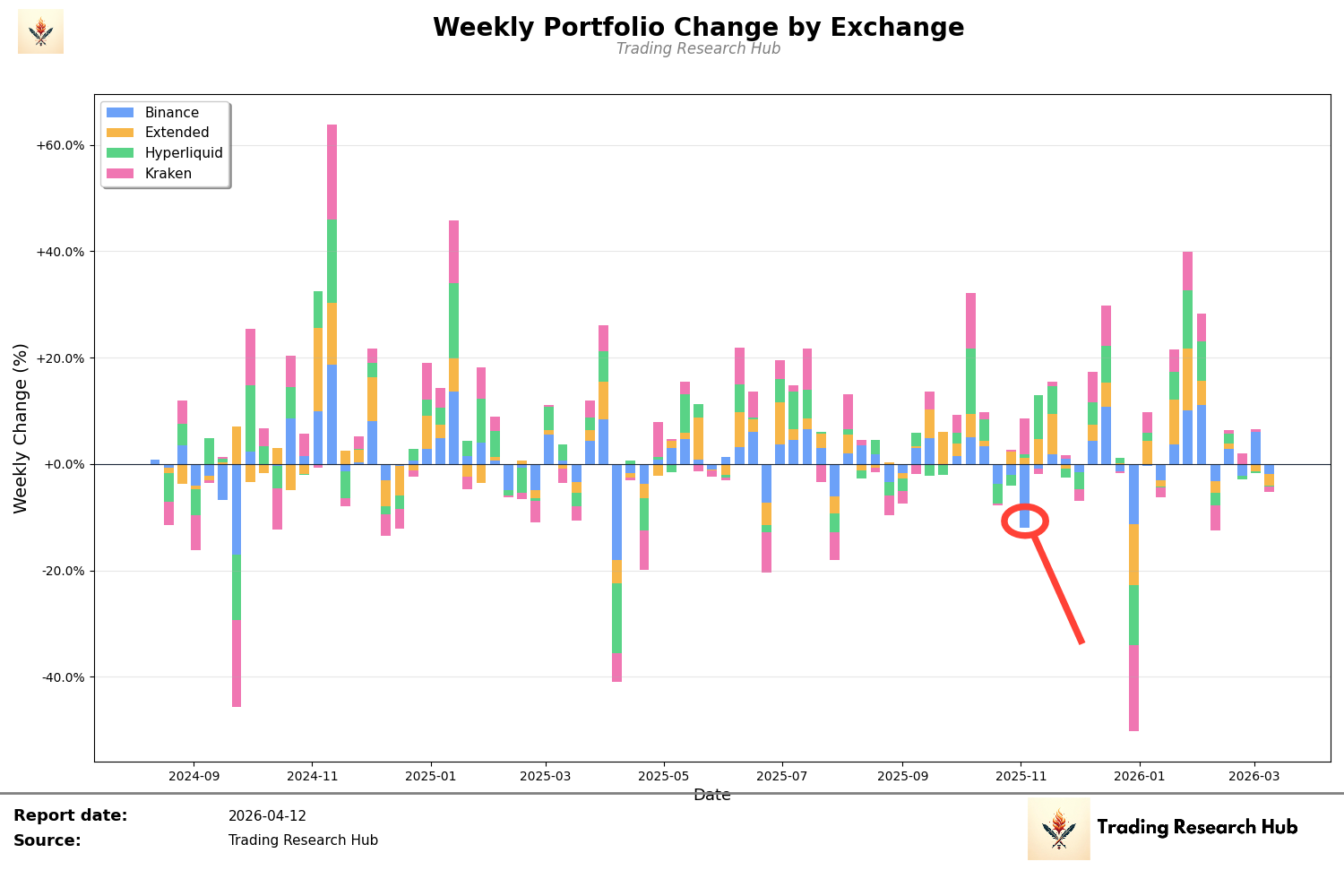
Most days the exchanges are pretty aligned in returns. This makes sense as the underlying model is the same. But something rather interesting happened in early November-25 (mostly on the 7th and 10th)…
You can see that only Binance lost money on that day, and pretty heavy, over 15% cut from yesterday’s equity.
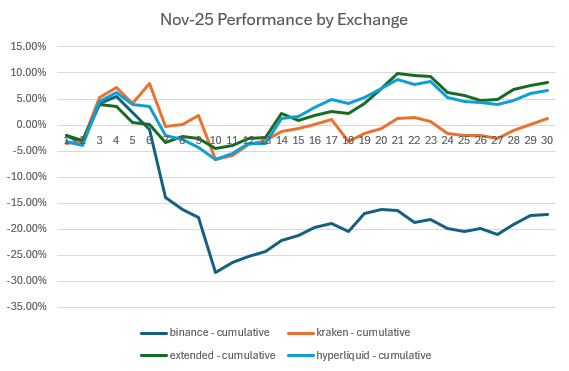
If we go into the excel of the open positions on those days, we can clearly see what I am saying. During November, most exchanges start virtually the same, but as it approaches the 7th, Binance accumulates major losses, where the others don’t.
Lets take a look at the individual losses on binance that differed from the other exchanges.